 BottleneckCalcs
Nvidia N1X (RTX Spark) Complete Guide
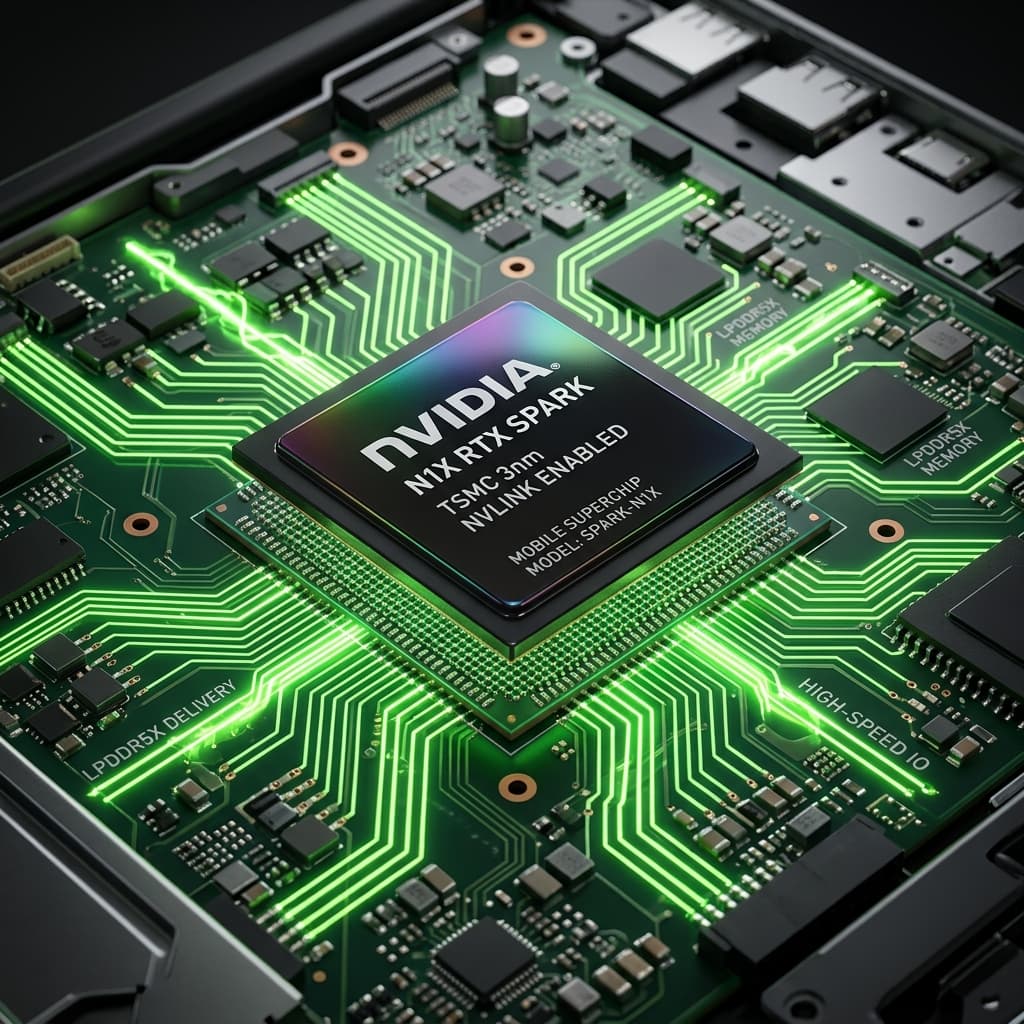
On June 1, 2026, at Computex 2026 in Taipei, Nvidia CEO Jensen Huang stepped onto the Taipei Music Center stage and made a decade-defining announcement: Nvidia is entering the consumer laptop CPU market for the first time. The chip — officially named the RTX Spark Superchip and widely known by its development codename N1X — is an ARM-based system-on-chip built with MediaTek, pairing a 20-core Grace CPU with a Blackwell GPU carrying 6,144 CUDA cores. It debuts in laptops from Dell, HP, Microsoft Surface, Lenovo, Asus, and MSI in Fall 2026.
This guide compiles everything confirmed from official sources and top-ranked tech publications to give you the most complete picture of the Nvidia N1X / RTX Spark — what it is, how it works, how it compares to the competition, and what it means for gamers, creators, and AI developers.
Table of Contents
- What Is the Nvidia N1X / RTX Spark?
- Full Technical Specifications
- Why the N1X Matters: A New Era of PC
- CUDA on Windows ARM — The Game Changer
- N1X vs Qualcomm, Intel, AMD & Apple Silicon
- OEM Laptops: Every Confirmed Device
- Gaming Performance on RTX Spark
- AI & Creator Workflows
- Pricing & Release Date
- From Leaks to Launch: The Long Road to N1X
- Frequently Asked Questions
1. What Is the Nvidia N1X / RTX Spark?
The Nvidia N1X — officially branded as the RTX Spark Superchip — is Nvidia's first ARM-based system-on-chip (SoC) designed for Windows laptops and compact desktop PCs. It represents the company's re-entry into consumer CPU silicon after more than a decade absent from the space.
Co-developed with MediaTek and closely tied to Microsoft's Windows on ARM platform, the chip is essentially a mobile variant of the same GB10 silicon used in Nvidia's DGX Spark desktop workstation. It pairs two chiplets — a MediaTek-designed Grace CPU die and a Nvidia Blackwell GPU die — in a 2.5D package built on TSMC's 3nm process, connected via Nvidia's NVLink C2C interconnect at 300 GB/s bidirectional bandwidth.
"This reinvention of the computer is as big of a deal as the reinvention of the phone into what we now know as the smartphone." <cite>— Jensen Huang, CEO, Nvidia — GTC Taipei Keynote, June 1, 2026</cite>
Key Highlights
- CPU Cores: 20 (10P + 10E ARM v9.2 cores)
- CUDA Cores: 6,144 (Blackwell architecture — RTX 5070-class)
- AI Throughput: 1 PFLOPS (FP4 precision / NVFP4)
- Unified Memory: Up to 128 GB LPDDR5X-9400, shared CPU+GPU
- Memory Bandwidth: ~301 GB/s (256-bit bus LPDDR5X)
- FP32 Performance: 31 TFLOPs GPU floating-point performance
2. Full Technical Specifications
Below is a consolidated spec sheet based on Nvidia's official Computex 2026 disclosure, Hot Chips 2025 presentation data, and confirmed pre-launch leaks from Geekbench and VideoCardz.
N1X (RTX Spark — High-Performance Tier)
| Spec | Detail |
|---|---|
| Codename / Brand | N1X / RTX Spark Superchip |
| Process Node | TSMC 3nm (N3) |
| CPU Architecture | ARM v9.2 (20 cores: 10 Performance + 10 Efficiency) |
| CPU Designer | Nvidia Grace (co-developed with MediaTek) |
| L3 Cache | 32 MB shared |
| GPU Architecture | Nvidia Blackwell |
| CUDA Cores | 6,144 (48 Streaming Multiprocessors) |
| Tensor Cores | 5th-Gen with NVFP4 precision |
| Ray Tracing Cores | Yes (dedicated RT cores) |
| FP32 Performance | 31 TFLOPs |
| AI Throughput | 1 PFLOPS (FP4) |
| Unified Memory | Up to 128 GB LPDDR5X-9400 |
| Memory Bus | 256-bit |
| Memory Bandwidth | ~301 GB/s |
| Chiplet Interconnect | NVLink C2C @ 300 GB/s bidirectional |
| Package | 2.5D heterogeneous (CPU die + GPU die) |
| TDP (Laptop) | 45–80W |
| PCIe Lanes | 8× PCIe 5.0 + 3× PCIe 4.0 |
| Storage | Up to 2× M.2 SSDs |
| DLSS Support | DLSS 4.5 (Multi Frame Generation) |
| G-Sync / Reflex | Yes |
| OS | Windows 11 on ARM |
N1 (Standard / Efficiency Tier) — Also Announced
| Variant | CPU Cores | CUDA Cores | TDP |
|---|---|---|---|
| N1 (High) | 12-core (8P+4E) | 2,560 | 18–45W |
| N1 (Base) | 10-core (7P+3E) | 2,048 | 18–45W |
[!TIP] Pro Tip for PC Builders: The RTX Spark/N1X uses unified shared memory — the GPU draws from the same LPDDR5X pool as the CPU. This means the GPU's effective bandwidth (~273–301 GB/s) is lower than a discrete laptop GPU running dedicated GDDR7 memory. For AI inference and creative workflows, shared memory is a massive advantage. For pure gaming throughput, discrete GPUs still lead on raw bandwidth.
3. Why the N1X Matters: A New Era of PC
The coordinated reveal on May 30 — Nvidia, Microsoft, and Arm all posting "A new era of PC" alongside coordinates pointing to Taipei — was not marketing hyperbole. It was a signal that three of the most important players in computing had aligned to back a new platform architecture.
For PC enthusiasts and builders, the significance runs deep. Nvidia told CNBC in February 2026 that CPUs were "becoming the bottleneck" in agentic AI workflows. The RTX Spark directly addresses that by bringing Nvidia's full software stack — CUDA, TensorRT, DLSS, Reflex — into the laptop form factor for the first time, running on Windows ARM natively.
This is also Nvidia's return to consumer CPU silicon after more than a decade. The company previously made the Tegra line of ARM chips for mobile devices before exiting that market. The N1X marks a fundamentally different ambition: to own the full compute stack — CPU, GPU, AI accelerators, memory, and software — in a single unified package for the PC.
Nvidia expects to ship more than 30 laptops and 10 desktop PCs powered by RTX Spark across all partners — the largest simultaneous Windows on ARM launch in history.
4. CUDA on Windows ARM — The Game Changer
The single most important differentiator of the N1X over every existing Windows ARM chip — including Qualcomm's Snapdragon X platform — is the full CUDA software stack.
Qualcomm's platform runs on its proprietary QNN and DirectML stacks. Apple Silicon does not run Windows. The N1X changes the equation entirely by bringing Nvidia's entire developer ecosystem — TensorRT, PyTorch's CUDA backend, llama.cpp for CUDA, TensorRT-LLM, ComfyUI, and every other CUDA-native AI workflow — to a portable Windows machine for the first time.
What CUDA Unlocks on N1X Laptops:
- Local AI Models: Run quantized LLMs locally (up to 120B+ parameters) — DeepSeek, Llama, and Gemma variants.
- Adobe Integration: 2× faster rendering in Photoshop & Premiere via TensorRT.
- 3D Scenes: Blender with DLSS 4.5 Ray Reconstruction denoiser.
- Video Editing: 4K AI video generation & 12K video editing capability.
For machine learning researchers and AI developers, the practical impact is the ability to prototype, fine-tune, and run inference on large models locally without a cloud subscription or a dedicated workstation. Adobe is actively rebuilding Photoshop and Premiere Pro from the ground up to support TensorRT on RTX Spark.
On the gaming side, RTX Spark runs the full RTX stack — DLSS 4.5 Multi Frame Generation, Reflex, G-Sync, and complete ray tracing — bringing features previously reserved for discrete GPU laptops to a thin-and-light ARM device.
5. N1X vs Qualcomm, Intel, AMD & Apple Silicon
Pre-release Geekbench prototype results (June 2025 pre-production sample) give the first independent data points. Final shipping performance may differ, but the competitive landscape is taking shape.
| Metric | Nvidia N1X (RTX Spark) | Qualcomm Snapdragon X Elite | AMD Ryzen AI MAX+ 395 | Intel Core Ultra 9 285HX | Apple M4 Pro |
|---|---|---|---|---|---|
| Architecture | ARM v9.2 | ARM (Oryon) | x86 (Zen 5) | x86 (Arrow Lake) | ARM (Apple) |
| CPU Cores | 20 (10P+10E) | 12 | 16 | 24 | 14 |
| Geekbench Single-Core | 🟡 ~3,096 | 🔴 ~2,693 | 🟡 ~2,900 | 🟢 ~3,100 | 🟢 ~3,800 |
| Geekbench Multi-Core | 🟡 ~18,837 | 🔴 ~15,000 | 🟢 ~21,035 | 🟢 ~22,104 | 🟢 ~22,000 |
| GPU Core Count | 🟢 6,144 CUDA | 🔴 4 RDNA CUs | 🟢 40 RDNA 3.5 CUs | 🔴 Arc G3 iGPU | 🟡 20-core GPU |
| CUDA / RTX Stack | 🟢 Full CUDA + RTX | 🔴 No (QNN/DirectML) | 🔴 No (ROCm/DirectML) | 🔴 No (OpenVINO/DirectML) | 🔴 No (macOS only) |
| AI Throughput | 🟢 1 PFLOPS (FP4) | 🔴 ~45 TOPS (INT8) | 🔴 ~50 TOPS | 🔴 ~48 TOPS | 🔴 ~38 TOPS |
| Unified Memory (Max) | 🟢 128 GB | 🔴 64 GB | 🟢 128 GB (HBM3E) | 🔴 N/A (discrete) | 🔴 64 GB |
| Windows ARM Native | 🟢 Yes | 🟢 Yes | 🔴 No (x86 Windows) | 🔴 No (x86 Windows) | 🔴 No (macOS only) |
| CPU vs Apple M4 Pro | ⚠️ ~2 yrs behind | 🔴 Behind | 🟡 Comparable | 🟡 Comparable | 🟢 Reference |
[!WARNING] Important Context: All Geekbench figures for the N1X are from a June 2025 pre-production engineering sample. Final shipping results with optimized Windows drivers may differ significantly. No independent retail-unit benchmarks exist yet. GPU comparison assumes shared LPDDR5X memory (~273–301 GB/s) vs discrete GDDR7 in traditional laptop GPUs (~448 GB/s for RTX 5070 mobile).
Apple's AppleInsider notes that on raw CPU throughput, the N1X "is trailing behind a chip from Apple that's more than two years old." The competitive edge lies squarely in the CUDA ecosystem and GPU core count — areas where no other Windows ARM chip comes close.
6. OEM Laptops: Every Confirmed Device
Nvidia confirmed that more than 8 brands are launching RTX Spark laptops in Fall 2026, representing the largest coordinated Windows on ARM launch in history.
- Microsoft Surface Laptop Ultra: 🟢 Confirmed — Lead launch device. 128 GB RAM, mini-LED display.
- Dell XPS 16 (2026): 🟢 Confirmed — Embargoed launch May 31. Starting at $599 (XPS 13 confirmed).
- Lenovo Legion 7 N1X: 🟢 Confirmed — 245W PSU, gaming-focused. 80W TDP config.
- Lenovo Yoga Pro 9n: 🟢 Confirmed — Creator / thin & light focus.
- Lenovo IdeaPad Slim 5 / Yoga 9 2-in-1: 🟢 Confirmed internally.
- Asus ProArt P14 / P15: 🟢 Confirmed — Creator line. Tandem OLED display.
- HP OmniBook X 14 / Ultra 16: 🟢 Confirmed — Details TBA closer to launch.
- MSI Prestige N16 Flip AI+: 🟢 Confirmed — 16" UHD+ Tandem OLED, 99.9 Wh, stylus support.
- Acer: 🟡 Expected to follow — not yet named.
- Gigabyte: 🟡 Expected to follow — not yet named.
[!TIP] Will the N1X be a bottleneck in your build? The RTX Spark's unified memory pool means the GPU and CPU share bandwidth. Find out if this creates a bottleneck for your workflow with our free Bottleneck Calculator.
7. Gaming Performance on RTX Spark
Gaming is the most nuanced performance story for the N1X. The chip carries the same 6,144 CUDA core count as the desktop RTX 5070, but the GPU operates within a shared LPDDR5X memory pool delivering roughly 273–301 GB/s — meaningfully less than discrete-GPU laptops running GDDR7 memory at up to 448 GB/s.
The DGX Spark desktop (the N1X's workstation sibling, tested ahead of the laptop launch) achieved around 50 FPS in Cyberpunk 2077 at 1080p medium under Linux emulation — not its ideal environment. On native Windows with DLSS 4.5 Multi Frame Generation enabled, performance figures are expected to be considerably higher. Nvidia says RTX Spark is designed for 1440p gaming as its primary target, with DLSS frames filling in the gap.
What RTX Spark brings to gaming that no Windows ARM chip has before:
- DLSS 4.5 with Multi Frame Generation (up to 3 extra frames per native frame).
- Reflex latency reduction.
- G-Sync variable refresh rate support.
- Full ray tracing via dedicated RT cores.
- Native anti-cheat compatibility — Nvidia confirmed popular anti-cheat software runs natively on Windows ARM.
- Consistent plugged/unplugged performance — like Apple Silicon and other ARM SoCs, RTX Spark delivers similar performance whether on battery or AC power.
The Snapdragon X platform's chief weakness was always GPU performance. RTX Spark is explicitly designed to exploit that gap, and on shader count alone, the N1X GPU is in a completely different class from anything Qualcomm offers.
8. AI & Creator Workflows
This is where the N1X story gets most compelling. With 1 petaflop of FP4 AI compute and up to 128 GB of unified memory, the RTX Spark can run quantized language models up to roughly 120 billion parameters entirely in local RAM — no cloud required.
The same architecture in the DGX Spark desktop already supports local inference on DeepSeek, Meta Llama, and Google Gemma variants at the 200-billion-parameter scale. A laptop version of that silicon makes those workloads genuinely portable for the first time.
Adobe has confirmed it is rebuilding flagship software to specifically support TensorRT on RTX Spark, delivering up to 2× faster rendering, effects tracking, and AI-assisted workflows in Photoshop and Premiere Pro. Blender is integrating DLSS 4.5 Ray Reconstruction as a real-time viewport denoiser, enabling seamless manipulation of massive 3D scenes.
The massive unified memory pool also eliminates a common bottleneck in AI workflows on traditional laptops: the need to transfer data between CPU RAM and dedicated GPU VRAM. On the N1X, the CPU and GPU both see the same 128 GB pool at high bandwidth — particularly advantageous for multimodal AI models that move data between language and vision components frequently.
[!NOTE] External Resource: For developers wanting to explore the RTX Spark software ecosystem, Nvidia's developer blog at developer.nvidia.com/blog covers TensorRT, CUDA, and the latest model optimizations for the Grace Blackwell platform.
9. Pricing & Release Date
Nvidia has confirmed that initial RTX Spark devices will target the premium segment but has not disclosed official pricing. Based on available information:
| Device / Tier | Expected Price | Availability |
|---|---|---|
| N1X laptops (analyst estimates) | $1,000–$1,500+ | Fall 2026 |
| Dell XPS 13 (confirmed base) | From $599 | Fall 2026 |
| N1X premium tier (Tom's Hardware estimate) | $2,000+ (MacBook Pro class) | Fall 2026 |
| N1 laptops (standard tier) | Sub-$1,500 midrange | Late 2026 / 2027 |
| DGX Spark desktop (GB10 workstation) | $3,999 | Available now |
LPDDR5X memory costs and TSMC 3nm manufacturing make budget pricing unlikely at launch. Premium aluminum chassis, tandem OLED displays, and large glass touchpads are standard across the confirmed lineup — reflecting a deliberate positioning against the MacBook Pro. Broader mainstream availability is expected into early 2027 as yields improve and the N1 (lower-cost tier) ramps.
10. From Leaks to Launch: The Long Road to N1X
The N1X was not an overnight project. Its journey from rumor to product spans three years of leaks, delays, and near-misses:
| Date | Milestone |
|---|---|
| 2023–2024 | Early supply chain leaks surface "N1X" as Nvidia ARM SoC for Windows laptops. Internal documents date to 2024 appear in later leaks. |
| June 2025 | N1X engineering sample spotted on Geekbench (~3,096 / ~18,837 scores). FurMark benchmark appears ("NVIDIA JMJWOA" codename). Planned Computex 2025 reveal missed. |
| Late 2025 | Reports surface of hardware delays; OEM partners describe Windows ARM compatibility as "a nightmare." Launch pushed to Q2 2026. |
| February 2026 | Nvidia tells CNBC CPUs are "becoming the bottleneck" in AI workflows. Software fixes continue. |
| May 30, 2026 | Nvidia, Microsoft, and Arm simultaneously post "A new era of PC" with Taipei coordinates. Dell XPS embargo breaks. Lenovo Legion spec sheets leak. Full N1X/N1 specs published by VideoCardz. |
| June 1, 2026 | Jensen Huang officially announces RTX Spark Superchip (N1X) at GTC Taipei, Computex 2026. Microsoft Surface Laptop Ultra, Dell, HP, Lenovo, Asus, MSI confirmed. |
| Fall 2026 | First RTX Spark laptops reach retail. 30+ laptop models, 10+ desktops planned. |
11. Frequently Asked Questions
Is the Nvidia N1X the same as the RTX Spark?
Yes. "N1X" was the pre-announcement codename used throughout the development period and in leaks. At Computex 2026, Nvidia officially launched the chip under the commercial brand name RTX Spark Superchip. Jensen Huang used both names interchangeably during the keynote.
When will N1X / RTX Spark laptops be available to buy?
Nvidia and its OEM partners have confirmed Fall 2026 availability for the first wave of RTX Spark laptops. Broader availability, including lower-cost N1-based models, is expected through early 2027.
Can the Nvidia N1X run standard Windows apps and games?
Yes, it runs Windows 11 on ARM. Most modern apps and games work natively or via Microsoft's x86 emulation layer. There are known compatibility caveats — particularly with some legacy x86 apps and certain DRM systems — though Nvidia confirmed popular anti-cheat software runs natively. x86 emulation typically achieves around 80% of native performance, so some older titles may see a performance penalty.
How does RTX Spark compare to Apple M4 Pro?
In raw CPU performance, Apple Silicon leads — the M4 Pro scores roughly 20–25% higher in single-core benchmarks than the current N1X prototype. However, the N1X carries far more GPU compute power (6,144 CUDA cores vs. 20 GPU cores), the full RTX gaming stack, and CUDA support — none of which are available on Apple Silicon for Windows workflows.
Is the N1X good for gaming?
It targets 1080p and 1440p gaming with DLSS 4.5 assistance. The 6,144 CUDA core GPU matches the desktop RTX 5070 in core count, but operates with shared LPDDR5X memory (lower bandwidth than discrete GDDR7). The DGX Spark desktop (same silicon) ran Cyberpunk 2077 at ~50 FPS in 1080p medium under non-ideal conditions; optimized laptop drivers on Windows are expected to perform significantly better.
What is the N1 vs N1X difference?
The N1X is the high-performance tier: 20 cores (10P+10E), 6,144 CUDA cores, 45–80W TDP. The N1 is the efficiency/midrange tier: 12-core (8P+4E) or 10-core (7P+3E) configs with 2,560 or 2,048 CUDA cores at 18–45W — better suited for thinner, longer-battery designs at lower price points.
Does the N1X have a bottleneck due to shared memory?
For AI and creative workflows, shared memory is an advantage — the GPU can access the full 128 GB pool without VRAM limits, eliminating traditional GPU memory bottlenecks. For gaming, the GPU operates at ~273–301 GB/s of memory bandwidth versus ~448 GB/s for a discrete laptop RTX 5070 mobile running GDDR7. This bandwidth gap can limit peak gaming throughput in memory-intensive titles. Use our Bottleneck Calculator to model specific workloads.
Sources & Further Reading
- Nvidia RTX Spark Official Product Page
- Nvidia DGX Spark Workstation
- GTC Taipei / Computex 2026 Keynote
- Nvidia jumps into PCs with new Arm-based chip (CNBC)
- Nvidia unveils RTX Spark Superchip — Tom's Hardware
- N1X officially confirmed as RTX Spark (NotebookCheck)
- Nvidia RTX Spark — Wikipedia
- Nvidia ARM Laptop Chip N1X Confirmed for Computex (TechTimes)
- N1X specs leak ahead of Computex launch (XDA Developers)
- Nvidia Debuts RTX Spark at Computex 2026 (Back2Gaming)
- Nvidia's N1X Apple Silicon rival is two years behind (AppleInsider)
- Nvidia Developer Blog — CUDA & RTX resources

Adam Roy
Founder of BottleneckCalcs and hardware performance expert. Adam specializes in PC architecture, web optimization, and creating data-driven tools for the hardware community.
View Full ProfileOptimizing your build?
Use our Bottleneck Calculator to ensure your CPU and GPU are perfectly matched for your next upgrade.
Check Your Bottleneck